

Beetle bloopers
Flightless insects on windswept islands
Even a defect can be an advantage sometimes
A big obstacle for evolutionary belief is this: what mechanism could possibly have added all the extra information required to transform a one-celled creature progressively into pelicans, palm trees, and people? Natural selection alone can’t do it—selection involves getting rid of information. A group of creatures might become more adapted to the cold, for example, by the elimination of those which don’t carry enough of the genetic information to make thick fur. But that doesn’t explain the origin of the information to make thick fur.
For evolutionists there is only ‘one game in town’ to explain the new information which their theory requires—mutations. These are accidental mistakes as the genetic information (the coded set of instructions on the DNA which is the ‘recipe’ or ‘blue-print’ specifying the construction and operation of any creature) is copied from one generation to the next. Naturally, such scrambling of information will tend to either be harmful,1 or at best neutral.2
However, evolutionists believe that occasionally, a ‘good’ mutation will occur which will be favored by selection and will allow that creature to progress along its evolutionary pathway to something completely different.
The wrong type of change
Are there ‘good’ mutations? Evolutionists can point to a small handful of cases in which a mutation has helped a creature to survive better than those without it. Actually, they need to take a closer look. Such ‘good’ mistakes are still the wrong types of changes to turn a fish into a philosopher—they are headed in precisely the wrong direction. Rather than adding information, they destroy information, or corrupt the way it can be expressed (not surprising, since they are random mistakes).
For example, beetles losing their wings. A particular winged beetle type lives on large continental areas; the same beetle type on a small windy island has no wings.
What happened is easy to imagine. Every now and then in beetle populations, there might be a mutational defect which prevents wings from forming. That is, the ‘wing-making’ information is lost or scrambled in some way.
The damaged gene (a gene is like a long ‘sentence’ carrying one part of the total instructions recorded on the DNA) will then be passed to all that beetle’s offspring, and to theirs, as it is copied over and over. All these descendant beetles will be wingless.
If a beetle with such a wingless defect is living on the Australian mainland, for example, it will have less chance to fly away from beetle-eaters, so it will be more likely to be eliminated by ‘survival of the fittest’ before it can leave offspring. Such so-called ‘natural selection’ can help to eliminate (or at least reduce the buildup of) such genetic mistakes.
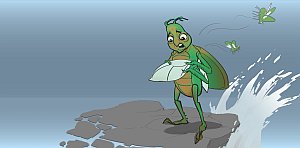
Blown away
However, on the windy island, the beetles which can fly tend to get blown into the sea, so not having wings is an advantage. In time, the elimination of all the winged ones will ensure that only those of this new ‘wingless’ variety survive, which have therefore been ‘naturally selected.’ ‘There!’ says the evolutionist. ‘A favorable mutation—evolution in action!’ However, it fails to make his case, because though beneficial to survival, it is still a defect—a loss or corruption of information. This is the very opposite of what evolutionists need to demonstrate real evolution.
To support belief in a process which has allegedly turned molecules into man would require mutations to add information. Showing that information-losing defects can give a survival advantage is irrelevant, as far as evidence for real evolution is concerned.
In short,
- Evolutionary theory requires some mutations to go ‘uphill’—to add information.
- The mutations which we observe are generally neutral (they don’t change the information, or the ‘meaning’ in the code) or else they are informationally downhill—defects which lose/corrupt information.
- The rare ‘beneficial’ mutations to which evolutionists cling, all appear to be like this wingless beetle—downhill changes, losses of information which, though they may give a survival advantage, are headed in precisely the wrong direction for evolution.
All of our real-world experience, especially in the ‘information age,’ would indicate that to rely on accidental copying mistakes to generate real information is the stuff of wishful thinking by ‘true believers,’ not science.
Re-posted on homepage: 27 July 2022
Notes
- Thousands of hereditary diseases in people, for instance, are caused by just such inherited mutational defects. Return to text.
- That is, having no effect on the outcome, or the expressed meaning of the code. Using English as an (admittedly limited) analogy, assume a message were transmitted saying ‘the enemy is now attacking,’ which accidentally suffers a one-letter substitution changing it to ‘the enemy is not attacking.’ The result is potentially disastrous, like a harmful mutation. Whereas a change to ‘tha enemy is now attacking’ would be neutral; a change, but not affecting the end result. Return to text.


Readers’ comments
Comments are automatically closed 14 days after publication.