

Sensational dinosaur blood report!
Actual red blood cells in fossil bones from a Tyrannosaurus rex? With traces of the blood protein hemoglobin (which makes blood red and carries oxygen)? It sounds preposterous—to those who believe that these dinosaur remains are at least 65 million years old.
It is of course much less of a surprise to those who believe Genesis, in which case dinosaur remains are at most only a few thousand years old.
In a recent article,1 scientists from Montana State University, seemingly struggling to allow professional caution to restrain their obvious excitement at the findings, report on the evidence which seems to strongly suggest that traces of real blood from a T. rex have actually been found.
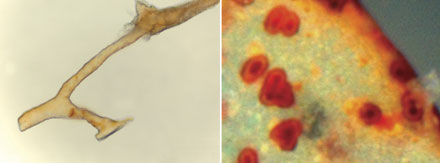
Left: The flexible branching structures in the T. rex bone were justifiably identified as “blood vessels”. Soft tissues like blood vessels should not be there if the bones were 65 million years old.
Right: These microscopic structures were able to be squeezed out of some of the blood vessels, and can be seen to “look like cells” as the researchers said. So once again there is scope for Dr Schweitzer to ask the same question, “How could these cells last for 65 million years?”
The story starts with a beautifully preserved T. rex skeleton unearthed in the United States in 1990. When the bones were brought to the Montana State University’s lab, it was noticed that ‘some parts deep inside the long bone of the leg had not completely fossilized.’ To find unfossilized dinosaur bone is already an indication more consistent with a young age for the fossils (see More on fresh dino bone, below).
Let Mary Schweitzer, the scientist most involved with this find, take up the story of when her co-workers took turns looking through a microscope at a thin section of this T. rex bone, complete with blood vessel channels.
‘The lab filled with murmurs of amazement, for I had focused on something inside the vessels that none of us had ever noticed before: tiny round objects, translucent red with a dark center. Then a colleague took one look at them and shouted, “You’ve got red blood cells. You’ve got red blood cells!”’2
Schweitzer confronted her boss, famous paleontologist ‘Dinosaur’ Jack Horner, with her doubts about how these could really be blood cells. Horner suggested she try to prove they were not red blood cells, and she says, ‘So far, we haven’t been able to.’
Looking for dinosaur DNA in such a specimen was obviously tempting. However, fragments of DNA can be found almost everywhere—from fungi, bacteria, human fingerprints—and so it is hard to be sure that one has DNA from the specimen. The Montana team did find, along with DNA from fungi, insects and bacteria, unidentifiable DNA sequences, but could not say that these could not have been jumbled sequences from present-day organisms. However, the same problem would not be there for hemoglobin, the protein which makes blood red and carries oxygen, so they looked for this substance in the fossil bone.
More on fresh dino bone …
To claim that bone could remain intact for millions of years without being fossilized (mineralized) stretches credulity. The report here of red blood cells in an unfossilized section of dinosaur bone is not the first time such bone has been found.
Biologist Dr Margaret Helder alerted readers of Creation magazine to documented finds of ‘fresh’, unfossilized dinosaur bone as far back as 1992.3
The evidence that hemoglobin has indeed survived in this dinosaur bone (which casts immense doubt upon the ‘millions of years’ idea) is, to date, as follows:
- The tissue was coloured reddish brown, the colour of hemoglobin, as was liquid extracted from the dinosaur tissue.
- Hemoglobin contains heme units. Chemical signatures unique to heme were found in the specimens when certain wavelengths of laser light were applied.
- Because it contains iron, heme reacts to magnetic fields differently from other proteins—extracts from this specimen reacted in the same way as modern heme compounds.
- To ensure that the samples had not been contaminated with certain bacteria which have heme (but never the protein hemoglobin), extracts of the dinosaur fossil were injected over several weeks into rats. If there was even a minute amount of hemoglobin present in the T. Rex sample, the rats’ immune system should build up detectable antibodies against this compound. This is exactly what happened in carefully controlled experiments.
Evidence of hemoglobin, and the still-recognizable shapes of red blood cells, in unfossilized dinosaur bone is powerful testimony against the whole idea of dinosaurs living millions of years ago. It speaks volumes for the Bible’s account of a recent creation.
Re-posted on homepage: 10 May 2023
References and notes
- M. Schweitzer and I. Staedter, The Real Jurassic Park, Earth, pp. 55–57, June 1997. Return to text.
- The T. Rex blood cells were actually first noticed by a professional pathologist casually interested in looking at such an ‘old’ piece of bone under the microscope. Return to text.
- Creation 14(3):16–17. The secular sources were Geological Society of America Proceedings abstract. 17:548, also K. Davies in Journal of Paleontology 61(1):198–200. Return to text.


Readers’ comments
Comments are automatically closed 14 days after publication.