

Living for 900 years
A few people reach around 120 years. We’re understanding more … but, with new research, can we live longer? Fascinating new information about how and why we age casts fresh light on the long lifespans of pre-Flood people.

In the book of Genesis, the Bible routinely records human lifespans which seem outrageously different from our experience today. Adam lived to 930 years; Noah even longer, to 950 years (see graph below). These long lifespans are not haphazardly distributed; they are systematically greater before the Flood of Noah, and decline sharply afterwards.
These great ages are not presented in the Bible as if they are in any way extraordinary for their times, let alone miraculous.
Many people are quick to scoff at such ages, claiming they are ‘biologically impossible’. Today, even if they avoid all fatal diseases, humans will generally die of old age before they reach much past 100. Even the very exceptional cases don’t make it much past 120 years.
However, a look at the evidence related to aging suggests that the apparent upper limit on today’s average lifespans is not something that is ‘biologically inevitable’ as such for humans or other multi-celled creatures.
Disease, diet, ‘wear and tear’ and other environmental factors undoubtedly play a part in how long we live. However, it now appears that underlying all these are factors somehow written into our genetic code, which determine what our ‘upper limit’ is. This is not really surprising; most of us know of families in which nearly everyone lives to a ripe old age—and the opposite, of course.
And although an average ‘upper limit’ seems to be ‘programmed’ into each species, breeding experiments have shown that this limit can be altered, even dramatically. Experiments with fruitflies and worms have shown that extra longevity can be bred into and out of these populations. So you can have two populations of the same fly, with one group living many times longer than the other, on average. Even a genetic ‘switch’ involved in longevity has been identified in one species of worm.
Living beyond your means
In the 1960s, a middle-aged lawyer in France struck a deal with a lady client in her 90s, as follows. He gained ownership of her apartment, in return for a handsome monthly stipend. She could live in it rent-free all her life.
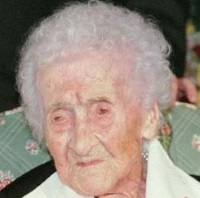
It seemed an obvious win-win; because of her advanced age, he would surely end up with a very cheap purchase, and she would live out her meagre allotment of remaining years with a high income.
To the lawyer’s great misfortune, his client, Jeanne Calment, was destined to become the longest living person in modern history. She died in 1997 (with all faculties intact) at the age of 122 years, 164 days. Her lawyer died of old age long before she did. He (and his estate) ended up paying her the price of her apartment many times over.
Two French researchers have recently traced Calment’s genealogy back five generations on both sides. Each of her ancestors had lived a remarkable 10.5 years longer, on average, than the mean age at death of people in the same region. They concluded that how she lived or what she ate was not the main factor in her great age, but that a rare constellation of longevity genes must have come together in one individual. Obviously, she also happened to avoid any misfortune which might have caused earlier death.
This is consistent with our thesis here there are genetic longevity factors. The availability of a great array of these in our pre-Flood ancestors might well explain their long lifespans, while loss of some could explain the subsequent drop.
Why do we wear out?
Why is it that multi-celled creatures (like people) all eventually wear out and die? It is not enough to simply say that there are physical laws which dictate that all fixed structures will eventually wear out. This is true, but biological machinery has built-in ‘intelligence’ (programmed into the DNA) which gives it the ability to repair itself.
That’s why single-celled creatures like bacteria don’t die of old age—they just divide into two new copies, each of which divides into two more, and so on. [Note added May 2009, modified March 2014: Actually, there is now abundant evidence that single-celled creatures can in fact suffer senescence—i.e., aging and death, though being able to split off an identical ‘fresh copy’ suggests it is not completely comparable. Conversely, the Royal Society blog on 27 March 2014 wrote of the multi-celled creatures known as hydra: “There is some evidence to suggest that hydra possess biological immortality – failing an accident or carelessness … they can reproduce by budding and don’t exhibit obvious senescence (aging to death)”.] Beings like us have organs (e.g., liver, kidneys and so on) which are made up of lots of individual cells. Why don’t these cells keep on dividing, repairing and renewing the organ forever? If this were to happen, with worn-out cells replaced by newly manufactured ones, then none of your ‘parts’ would wear out. Which of course means that you would never wear out. You might be killed by a falling tree, or die of some infection, but you would never die of old age.
Of course, this isn’t so. Our individual organs do wear out. The cells within them can multiply for a while, but not forever. After a certain number of times, they simply stop dividing. It is known that ordinary human cells will only divide some 80–90 times, then no more.
It appears that there is, on the tips of each of our chromosomes, a structure called a telomere. Think of it as a counting device, with a number of beads on the end. Every time the cell divides, it is as if a bead is snipped off, shortening the telomere (see section below).1 Once all of the beads have gone, cell division can no longer take place. From then on, as each cell ‘runs down’, it is not replaced by any new ones. So even if you avoid any sort of fatal accident or disease, you will eventually succumb to failure of one or more organs.
The machinery by which cells divide is controlled by the instructions written on the DNA, the genetic code. So it looks as if some pre-programmed genetic limit, while not all there is to aging, could well be a big part of the story. In short, there is no known biological reason why lifespans of 900 years or more would be impossible if that genetic limit were set at a different point.
And there is reason to think that there could indeed be great variation in this genetic ‘upper limit’. We have already seen that simply reshuffling gene frequencies through breeding selection in fruitflies can drastically increase their lifespan.
The real question then becomes not, ‘How could they possibly live for so long?’, but rather, ‘Why don’t we live that long any more?’
How do lifespans compare?

Ignoring death by accident or disease, different living things seem to be genetically programmed to live for different average periods. Evidence is accumulating that such programs are not completely fixed—selective breeding in some creatures has drastically increased the average lifespan.
Noah’s new environment
Looking at the drop in lifespans after the Flood, it is natural to think that it must be related to the world having changed so drastically. Evidence from the fossil record does suggest that carbon dioxide (also possibly oxygen) levels were higher in the pre-Flood world. Many have suggested that an atmospheric canopy of water vapour sheltered the pre-Flood world from cosmic radiation. However, even if this were so [CW 2022: since this article was first published the canopy theory has been abandoned by CMI and virtually all major creationist scientists—see Arguments not to use], there is little evidence that aging is substantially influenced by any of these factors.
The idea that the environment became so much more ‘toxic’ after the Flood as to slash our lifespans by nearly eight centuries, to one-ninth of what they were, stumbles at one important point. Noah was already over 600 years old when he stepped out of the Ark. But this allegedly much more hostile environment did not cause him to rapidly wither and die in a few decades. Instead, he lived for another 350 years, outstripping the age of even his ancestor Adam.
We don’t know whether environmental factors perhaps only cause problems in the developmental phase of human life. However, one simple explanation of why Noah still lived for so long is that Noah’s genetic make-up was what gave him the potential to live so long. And that perhaps most, if not all, people before the Flood were programmed for much longer lifespans than we are programmed for today.
So what happened? Remember that the whole population shrank to just a handful. There are well known ways in which forms of genes (known as alleles), which could include any coding for longer lifespans, can be eliminated from a population that has gone through such a ‘bottleneck’—down to eight people (see box).
Other factors
If such genetic loss were the reason for the decline in lifespans, it may not be the only one. Harmful mutations accumulating at higher rates may have played a part. Some of these mutations may have caused a loss of the length of the telomere, for instance. [CW 2022: Years after this article was published, Dr John Sanford’s landmark work on genetic entropy has focused even greater attention on the high likelihood that mutational accumulation is a key factor—perhaps even the key factor—in the declining patriarchal ages, which are a good fit to a mathematical decay curve, see The rapid decline in biblical lifespans.] After the Flood, the variety of plants available for food was drastically reduced, perhaps one reason why God permitted man to eat meat at that point. However, not even the most avid enthusiast for healthy eating would suggest that, by simply changing our diet, we could live for 950 years today. Perhaps some of these other factors are the reason for the continuing decline, lasting for centuries. Isaac lived to 180, Moses 120, King David only 71 years. Interestingly, we are seeing an increase in lifespans today due to environmental factors. However, I think it is likely that to live anywhere near as long as our ancestor Noah, we would need some of his genetic factors.
Of course, the ultimate reason for all aging and death is the Curse on all creation recorded in Genesis chapter 3. Adam was told that if he disobeyed God, ‘dying, you shall die’ [lit. Hebrew]. Adam immediately died spiritually, and began to die physically on the very same day, just as we are all dying today.
Modern genetic research shows that we all inherit the inevitability of aging and death. When we look at our encroaching wrinkles in the mirror, it should remind us of the awfulness of sin in the sight of a holy God. And it should cause us immense thankfulness that God has provided a way of escape from His own righteous judgement on sin, through His Son, the Lord Jesus Christ.
Genetic loss after the Flood—a cause for dropping lifespans?
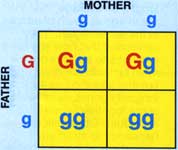
Possible genetic combinations inherited by offspring.
There is a well-known and simple phenomenon called ‘genetic drift’, through which varying forms (alleles) of genes (stretches of DNA coding for various characteristics) can become lost in small populations.
Genes come in pairs; you inherit one from your mother and one from your father. In the example shown above diagrammatically, the ‘G’ form of the gene is present in father and not in mother. Each of their children only has a 50–50 chance of inheriting the ‘G’ version of that particular gene, as shown. Therefore the possibility that none of the offspring will inherit this gene is not at all a remote one. (If they only have three children, the chance is 1 in 8). In a situation in which the entire human race was reduced down to Noah, his three sons and their wives, it is entirely feasible that some forms of the genes present in Noah were not passed on. Since it now appears that much of aging is under genetic control, loss of some of the genes for longevity may be the reason for the drop post-Flood. Perhaps subsequent population bottlenecks (at Babel) contributed further to this genetic elimination.2
The countdown to death

The ‘capping’ at the end of each chromosome (called a telomere, from Greek τέλος telos = ‘end’ and μέρος merοs ‘part’) is, like the capped tips of shoelaces, necessary to prevent the ends fraying. The telomere shortens with each cell division—once the limit is reached, the cells can no longer divide. This is probably only one way in which our limited lifespans are ‘programmed’ into us. There is no biological reason at all why people could not live much longer than they do at present, if they had the appropriate genetic makeup.
It has long been known that there are human cells that can keep on dividing forever—cancer cells. These appear not to have the built-in ‘switch’ which tells cells to stop dividing, so they keep on making copies of themselves. This is why medical labs, which need to use human cell lines in their work, can be continually supplied with cells which are all the ‘offspring’ of one unfortunate person’s cancer. (Called HeLa cells, after Henrietta Lacks, the lady whose cancer it was). The HeLa cell line is effectively ‘immortal’ (unless existing HeLa cells were to all be physically destroyed).
Recently, laboratory results based on an enzyme3 that is involved with the replication of the telomere, have caused much excitement. Modified human cell lines have divided many times past their limit. Some speculate that such manipulations could cause people to live to much longer ages, providing they do not succumb to disease or accident in the meantime. Aging is certain to be much more complex than these simplified discussions, based on preliminary findings, might lead us to think. However, the evidence so far strongly suggests that genetics plays a major part.
Bibliography/further reading
- New Scientist: 22 Nov 1997, p. 7; 3 Jan 1998, p. 6; 7 Feb 1998, p. 14; 28 Feb 1998, p. 23.
- ‘Can science beat the body clock?’ Sunday Times (London), 18 Jan 1998, p. 15.
- ‘Extraordinary lifespans in ants: a test of evolutionary theories of aging’, Nature 389:958–960, 1997.
- ‘Why do we age?’ U.S. News & World Report, 18–25 Aug 1997, pp. 55–57.
- ‘Genetics of Aging’ Science 278(5337):407–411, 1997.
Re-posted on homepage: 21 December 2022
References and notes
- Simplified for brevity—there is a fluctuation in length, with a net shortening. In our brain cells, the telomere does not shorten. Return to text.
- This assumes that there was probably considerable variation in lifespans in the pre-Flood world, with some only programmed to live a maximum of say, 400 to 500 years. This may be why Noah’s sons failed to match his great age. Return to text.
- This enzyme, called telomerase, was discovered in 1980 by the winner of the 1998 Australia Prize, Prof. Elizabeth Blackburn. Without telomerase, cells cannot copy their ‘caps’. Prof. Blackburn, along with Carol Greider and Jack Szostak, were awarded the 2009 Nobel Prize in Physiology or Medicine “for the discovery of ‘how chromosomes are protected by telomeres and the enzyme telomerase.’” Return to text.


Readers’ comments
Comments are automatically closed 14 days after publication.