

Darwin’s real message: have you missed it?

Harvard’s renowned Professor Stephen Jay Gould1 was a vigorous anticreationist (and Marxist — see documentation), and perhaps the most knowledgeable student of the history of evolutionary thought and all things Darwinian. [He passed away in 2002.]
We were on the same side about one thing at least—the real meaning of ‘Darwin’s revolution’. And we both agreed that it’s a meaning that the vast majority of people in the world today don’t really want to face up to. Gould argued that Darwin’s theory was inherently anti-plan, anti-purpose, anti-meaning (in other words, was pure philosophical materialism). Also, that Darwin himself knew this very well and meant it to be so.
By ‘materialism’ he does not mean the drive to possess more and more material things, but the philosophical belief that matter is the only reality. In this belief system, matter, left to itself, produced all things, including the human brain. This brain then invented the idea of the supernatural, of God, of eternal life, and so forth.
It seems obvious why Christians who wish to compromise with evolution, and especially those who encourage others to do this, would not want to face this as the true meaning of Darwinism. Such ‘theistic evolutionists’ believe they can accept the ‘baby’ of evolution (thus saving face with the world) while throwing out the ‘bathwater’ of materialism. I will not here go into the many reasons why the evolution/long geological ages idea is so corrosive to the biblical Gospel2 (even if evolution could be seen as the plan and purpose of some ‘god’).
My purpose is (like Gould’s, but with a different motive) to make people aware of this very common philosophical blind spot, this refusal to wake up to what Darwin was really on about. Why is it true, as Gould also points out, that even among non-Christians who believe in evolution the vast majority don’t wish to face the utter planlessness of Darwin’s theory? Because they would then no longer be able to console themselves with the feeling that there is some sort of plan or purpose to our existence.3
The usual thing vaguely believed in by this majority of people (at the same time as they accept evolution) is some sort of fuzzy, ethereal, oozing god-essence—more like the Star Wars ‘force be with you’ than the personal God of Scripture. They usually obtain some comfort from a vague belief in at least the possibility of some sort of afterlife, which helps explain the success of movies like Flatliners and Ghost.4
Gould appeared to deplore these popular notions as unfortunate, illogical and unnecessary cultural hangups. He, of course, started from the proposition that evolution was true. He knew the real message of Darwin to be that ‘there’s nothing else going on out there—just organisms struggling to pass their genes on to the next generation. That’s it.’ In which case it is time for people to abandon comforting fairytales and wake up to this materialistic implication of evolution.
I also regard such notions (of cosmic purpose in a Darwinian world, of life-after-death without belief in the existence of the holy God of the Bible) as tragic fables, for different reasons. They lead people away from the vital revealed truths of Scripture, the propositional facts communicated by the Creator of the universe. It is also tragic that professing Christians can be deluded into embracing a philosophy (evolution) which is so inherently opposed to the very core of Christianity, and has done so much damage to the church and society.
Climbing the ladder
As evidence for this widespread desire to see purpose and plan in the planlessness of evolution, Professor Gould pointed to the overwhelming tendency among evolution-believers of all levels of education to see the message of Darwin as progress. Evolution was usually illustrated (even on the cover of some foreign translations of Stephen Gould’s books, much to his chagrin) as a ‘ladder of progress’ or similar.
Why is this?
Think of this. If the evolutionary scenario is true, then man’s arrival on the scene has come only at the end of an unspeakably long chain of events. For example, it would have taken 99.999% of the history of the universe to get to man. After life appears, two-thirds of its history on earth doesn’t get past bacteria, and for half of the remainder it stays at the one-celled stage! In order to escape the obvious (which is that in such an evolutionary universe, man has no possible significance, and just happened to come along), our culture, he argues, has had to view these vast ages as some sort of preparation period for the eventual appearance of man. This works if the idea of progress is clung to. The universe, then organisms, just got ‘better and better’, till finally we came along.
Puncturing myths
However, there is no hint of this popular mythology of ‘evolution-as-progress’ in Darwin’s ‘grand idea’. Variations happen by chance. Those organisms which happen, by chance, to suit their local environment more effectively and thus have a better chance to pass their genes on to the next generation, are favoured by natural selection. That’s all. In the theory, the giraffe that develops a longer neck is not a better giraffe—just one with a longer neck. Given a certain change in the environment, that long neck can just as easily be a disadvantage.
There is therefore nothing ‘inevitable’ about the appearance of man, or intelligent self-aware beings, for that matter. I would add to Gould’s comments my opinion that it is this belief in evolution as having been an ‘onwards and upwards’ force leading to us, and then to greater intelligence as a historical inevitability, which makes many dedicated evolutionists so sure that there must be intelligent aliens out there somewhere.
Radical
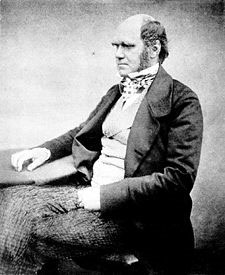
But didn’t Gould go a bit far to suggest that Darwin knew how radically anti-God his philosophy was? After all, wasn’t he a kindly, doddery naturalist who just happened to be in the right place at the right time, who was persuaded by what he saw in the Galápagos?
Wrong on all counts. If what follows sounds too revisionist, remember that Gould (an undisputed intellectual giant who has made a very careful study) is not alone in his conclusions, and has had access to unpublished notebooks of Darwin from when Darwin was a young man. It appears that:
- The myth of the ‘kindly slow-witted naturalist stumbling across evolution’ was fostered by an autobiography Darwin wrote as a deliberately self-effacing moral homily for his children, not intending it to be published. It was a common Victorian thing to do. His notebooks tell a different story, of an ambitious young man who knew he had one of the most radical ideas in the history of thought.
Darwin did not get his ideas from Galapagos finches—Gould even says ‘he clearly did not know they were finches’. About the Galapagos tortoises, he says that Darwin ‘missed that story also and only reconstructed it later.’ Did he get that from observing the results of animal breeding? Peter Bowler, writing in Nature (Vol. 353, October 24, 1991, p.713) says that ‘many now accept that Darwin’s analogy between artificial and natural selection was a product of hindsight’. So where did the idea come from?
Just prior to his famous ‘insight’, Darwin spent months studying the economic theories of Adam Smith. In Smith’s extreme free-market view, the struggle of individuals competing for personal gain in an unfettered marketplace (by eliminating inefficient participants, for instance) is supposed to give an ordered, efficient economy. Although nothing is guiding it, it is as if there is an ‘invisible guiding hand’. The ‘benefits come as an incidental side-effect of this selfish struggle.’
Of course, it is not hard to see where Darwin applied this idea to nature. The apparent design and order in nature is an incidental side-effect of the selfish struggle to leave more offspring.
Why did Darwin wait 20 years before publishing? It was not because of his modesty (another common myth which Gould debunks), so it is clear that he was afraid to reveal something.
Was it his belief in evolution itself? No. Evolution was quite a common concept in Darwin’s day. It was because of the bombshell he knew lay behind his theory, namely its rank, radical materialism. He knew as a young man that he had ‘the key to one of the great reforming ideas of history and systematically [went] out to reformulate every discipline from psychology to history.’5 To explain apparent design without a designer—that was the key to Darwin’s theory, not the idea of ‘evolution’ (common descent) itself.
- It is likely that this assault on design had a lot to do with a reaction against Captain Fitzroy6 on the Beagle. The captain’s views on almost all political subjects were diametrically opposite to Darwin’s. For instance, Darwin was an ardent abolitionist, whereas Fitzroy believed that slavery was benevolent. Apparently, the good captain would wax long and eloquent on Paley’s argument from design7, which was used to justify many of his ideas. Nothing could possibly have taken deadlier aim at Paley’s argument than Darwin’s persuasive concept that design is an incidental side-effect of otherwise random change.8
Darwin knew that his notion, being utter planlessness, could not possibly involve any sort of purposive progress, which is the romanticized notion of evolution held by so many of its believers today (especially theists). In fact, it is likely that this is why he did not, himself, use the word ‘evolution’ until his last book in 1881, when he gave in to the by then popular term applied to his concept. [Ed. note: Prof. Gould’s information seems to have been out by nine years here: Darwin did refer to his theory as ‘evolution’ in the sixth edition of the Origin, in 1872.] The common meaning of ‘evolution’ at that time implied progress. In a letter to the paleontologist Hyatt, Darwin wrote:
‘… I cannot avoid the conclusion that no inherent tendency to progressive development exists.’
Darwin’s casual aside about a ‘creator’ in earlier editions of The Origin of Species seems to have been a ploy to soften the implications of his materialistic theory. Ernst Mayr’s book on Darwin, One Long Argument: Charles Darwin and the Genesis of Evolutionary Thought, Harvard, 1991, also acknowledges that Darwin’s references to purpose were to appease both the public and his wife. His early, private notebooks show his materialism well established. For instance, in one of them he addresses himself as, ‘O, you materialist!’ and says, ‘Why is thought, being a secretion of brain, more wonderful than gravity as a property of matter?’ He clearly already believed that the idea of a separate realm of the spirit was nonsense, as is further shown when he warns himself not to reveal his beliefs, as follows:
‘to avoid saying how far I believe in materialism, say only that emotions, instincts, degrees of talent which are hereditary are so because brain of child resembles parent stock.’
In 1837, when Darwin was only 28 years old, he wrote in a private notebook, responding to Plato’s belief that the ideas of our imagination arise from preexistence of the soul, ‘read monkeys for preexistence’. He seems to have violently opposed Alfred Wallace’s suggestion of a ‘divine will’ behind the evolution of man, at least.9
In summary, then, Darwin was fully aware that his idea was a frontal assault on the very notion of an intelligent Designer behind the world. In fact, he might very well have formulated it precisely for that purpose. The idea of a spiritual realm apart from matter seems to have been anathema to him as a young man already. The primary inspiration for his theory of natural selection did not come from observation of nature. Perhaps not incidentally, his writings also reveal glimpses of specific antipathy to the God of the Bible, especially concerning His right to judge unbelievers in eternity.
Darwin knew, and virtually all the world’s foremost students of his idea know, that belief in his concept quite simply spells materialism with a capital ‘M’. The idea of no designer, no purpose, no guiding intelligence, no progressive plan —these are not afterthoughts to Darwin’s evolution, but form the very core of it. Accept Darwin’s ‘baby’, and this ‘bathwater’ has a nasty habit of coming along, as the drastic decline in belief among evolution-compromising churches attests.
One can only pray that more and more of the evolution-compromisers in the church begin to see the poisonous core of the fruit they not only swallow, but encourage others to accept. And that many of those outside of Christ will realize that there is no purpose in an evolutionary world. In any case, there is so much evidence stacked against evolution nowadays. True meaning to life can be found only through Jesus Christ, the non-evolutionary, miracle-working Genesis Creator, whose eternal Word is ‘true from the beginning’.
Re-posted on homepage: 24 July 2019
References and notes
- Much of the information (and all unreferenced quotes) in this article come from the transcript of a talk given by Dr Gould on June 6, 1990, at Victoria University, Wellington, New Zealand, titled ‘The Darwinian Revolution in Thought’. Return to text.
- See The Lie: Evolution, Master Books, El Cajon CA, 1987. See also Some questions for theistic evolutionists. Return to text.
- In my experience, among those who would really be called unbelievers by any common definition, the true atheist is nevertheless very rare. Most people are of course very quick to reject the holy God who is Creator and Judge (see Romans 1) and they readily seize upon evolution as an excuse to do so. It lets them be their own judge, do their ‘own thing’. However, they are very reluctant to take evolution to its logical conclusion which would mean rejecting all belief in any purpose to their existence, as this article contends. Return to text.
- Where the suggestion of some sort of afterlife judgment is allowed to come into the popular culture, it is a distortion of the biblical teaching that all are born sinful, and that repentance and faith in Jesus Christ is the only way to avoid the future judgment. Thus in the film Ghost, for example, we are given the strong impression that the hero is going to some heaven (despite blasphemy, fornication, and no hint of any Christian rebirth), whereas the one dragged off in post-mortem terror by ominous shadowy beings has already been revealed as an arch-villain. The message is that you have to be a really, really bad guy, commit murder even, to pay any penalty. Return to text.
- This description of Gould’s could easily lead to a caricature of Darwin as an extrovert, which overlooks other sides of his character. That he was timid as well as ambitious is shown by this 20-year delay (which might have been longer if not for Wallace’s impending publication of the same idea). His mysterious illness (long believed to be some form of anxiety neurosis) might have been contributed to by the conflict between these sides to his nature. In addition, of course, there was the psychological enormity of unleashing an idea upon the world which, as is clear from this article, he must have known would wipe out the whole concept of the biblical God from the minds of millions. Return to text.
- Contrary to another common misconception, Darwin was not the ship’s naturalist—that was the ship’s surgeon, called McCormack. Darwin was employed as the gentleman companion to the captain (with scientific work as an accepted sideline) because he was of sufficient social standing for the aristocratic Fitzroy, who would otherwise have had to eat alone and suffer great solitude, according to the conventions of the time. The price Darwin would have had to pay was to be continually regaled by the opinions of the overbearing Fitzroy for all those years. It was not the done thing to contradict the captain openly, either. Return to text.
- William Paley was a most influential thinker in that time, famous for his classic Natural Theology. His most renowned argument involved a comparison between the machinelike precision of living things and machines made by man. Thus, if a watch demands an intelligent watchmaker, how much more must nature demand an intelligent Creator? Unfortunately, such arguments were also used to justify deistic views of the universe which in turn justified all manner of social repression as having divine inevitability. Paley was not defending Genesis or the Bible as such. Return to text.
- This scenario is generally admitted in the theistic evolutionary opus Portraits of Creation, by Van Till, Snow, Stek, and Young, William B. Eerdmans Publishing Company, Grand Rapids, Michigan, p. 22, 1990. Return to text.
- Fix, W., The Bone Peddlers, Macmillan Publishing Company, New York, p. 213, 1984. Fix states that Darwin wrote to Wallace, ‘I differ grievously from you … I hope you have not murdered too completely your own and my child.’ (Wallace was the co-proposer of natural selection as a mechanism for evolution.) Return to text.


Readers’ comments
Comments are automatically closed 14 days after publication.